
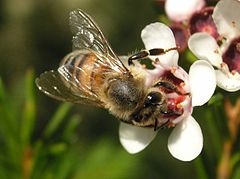
Fruits and vegetables that we enjoy everyday such as watermelon, oranges, carrots, onions and many more, often require more than just planting a seed in soil, watering and a little sun. In fact we owe much of our agricultural harvest success to a tiny little worker, that aids in pollination, called the bee. Pollination is defined as "process by which pollen is transferred in plants, thereby enabling fertilization and sexual reproduction" (Wikipedia)
Worldwide, there are over 20,000 species of bees, but the most efficient and commonly found one in agriculture is the European Honey Bee. More than half of our vitamin C intake is from plants that are pollinator dependent. Some pollinators include birds, butterflies and bats but none are as efficient as the honey bee.
In October of 2006, an epidemic occurred in which affected the population of honey bees greatly. Honey bees were dying in masses and became a phenomenon called "Colony collapse disorder (CCD). This was first seen happening in Pennsylvania, then Florida and spread from there. In California the decline in bee population threatened about 6 billion dollars in crops. By 2007, farmers began the purchasing and importing roughly 700,000 bees.
Though not one single reason has been accredited to the cause of CCD, The U.S Department of Agriculture conducted studies and research that showed possible related ties to poor nutrition, parasites, lack of genetic diversity, Pesticides - Insecticides, Antibiotics, and genetically modified crops that are designed to be insect resistant.
Currently researchers are looking to create a stronger and more resilient bee, by blending the population's genetics with stronger European honey bees.What we eat, how we treat our earth and it's inhabitants creates a cycle of actions that affect us all. Support true organic agriculture and learn more to know where your food comes from and what's in it.


 Jamie Kocher, the President of The Waimea Bay Chile Pepper Company has been organic gardening and farming for more than 35 years. His interest in organic gardening began at age 18 when he rented several community garden plots from the city of Long Beach while attending college. He has always had organic gardens, and to this day enjoys the satisfaction of growing most of his food and from sharing his knowledge and tricks of the trade to friends and acquaintances. He started an organic nursery in San Diego in 1985 and introduced the first “Mainland” hybrid bananas to this area in 1988. He moved back to the North Shore of Oahu in 1997 to surf more, and to get back to basics. As an airline pilot for American Airlines for 24 years he had the flexibility to commute to Los Angeles to work but would fly right back to Hawaii for his airline trip. His gardens utilize raised beds and the French intensive method, and the results are incredible. Typical Bhut Jolokia plants are 2 or 3 feet high and produce 30-50 fruits, but Jamie's organically grown Bhut Jolokia plants are 6-8 feet tall, with very thick trunks, and produce 200-250 fruits. He attributes this to his homemade compost, lots of TLC, and a lot of luck!